Beef-on-Dairy Summit: The 3 most stressful days in a beef-on-dairy calf’s life
Veterinarian Trey Gellert outlines how birth, weaning and transport shape lifetime performance and how producers can reduce risk
 27 April 2026
 3 minute read
 By:
By: Dr. Trey Gellert, a veterinarian at Four Star Veterinary Service based in Ohio, was recently interviewed by The Cattle Site’s Sarah Mikesell in Celina, Ohio, at the 2025 Beef-on-Dairy Producer Summit that is being hosted by Four Star Veterinary Service.
What are the three most stressful days for a beef-on-dairy calf?
The three most stressful days of a calf's life are going to be:
- the day it's born
- the day it's weaned
- the day it gets put on a truck for transport
This talk was focused on trying to set that calf up for success around those times - before weaning, during weaning, and after weaning.
Let's start with before weaning? What can producers do to reduce stress?
Before weaning, what we want to do is start programming the calf at a young age. We want to get stressful events done early.
- Vaccinate - we want to vaccinate the calf and get it to a good immune status prior to weaning.
- Dehorn/castrate - we want to dehorn and castrate the calf before we get to the point of weaning. The younger the better, but we don't want to do it around that time of weaning.
- Milk replacer - most important, we want to feed it plenty of milk replacer and get it big enough.
- Grain - push the grain intake. We want to jump start the rumen and development so the calf, when we do wean and remove it from milk, it's able to go right out and start on grain.
Let's talk now about around the time of weaning, what should producers be doing then?
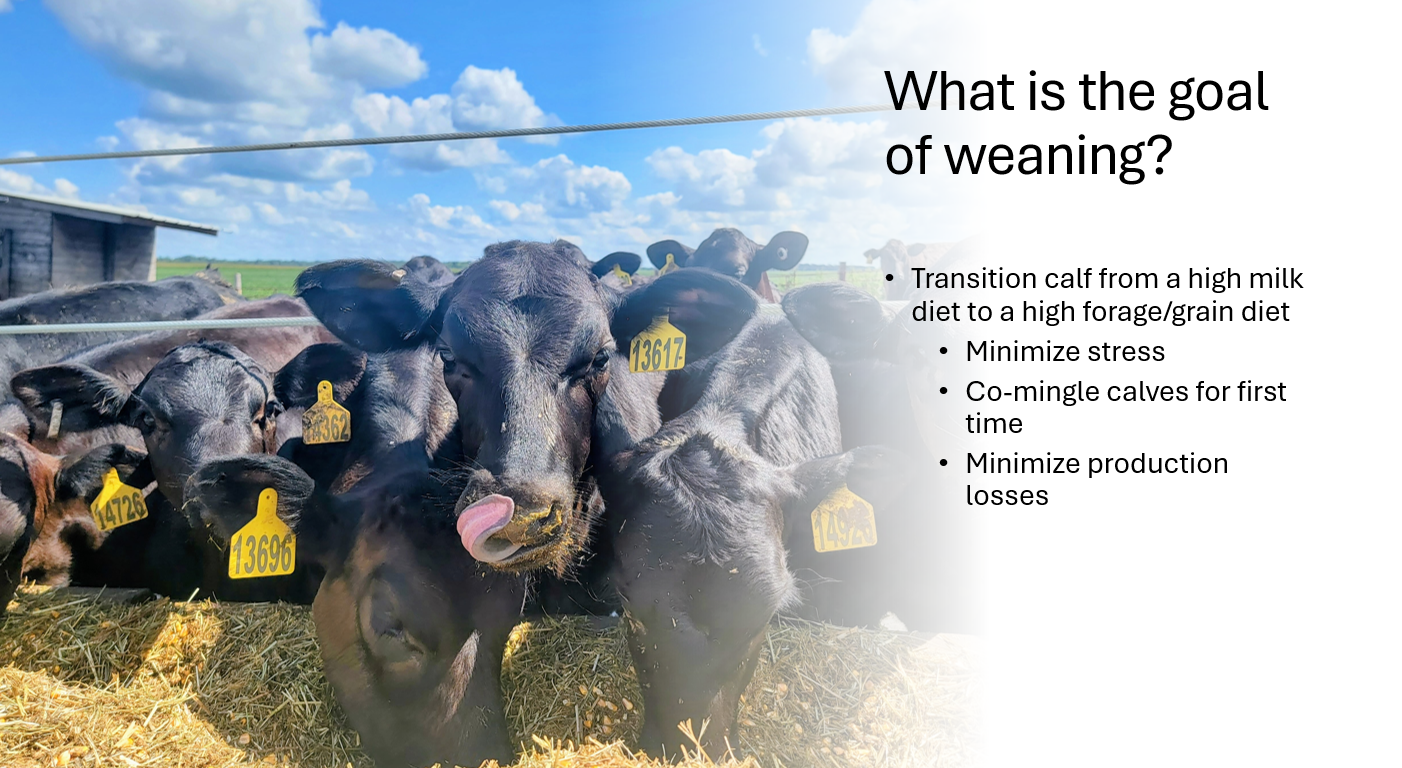
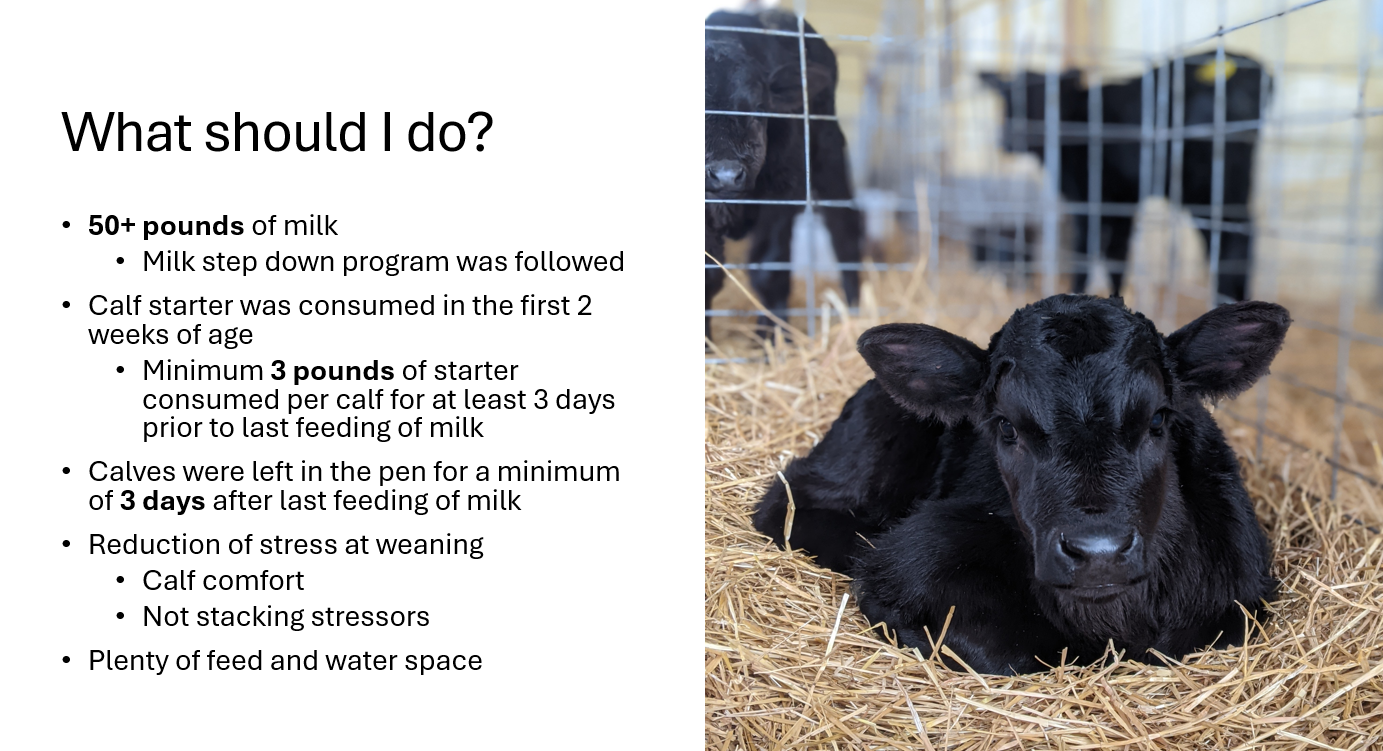
Weaning is full removal of milk, but around the time of weaning, start a milk step down program rather than going cold turkey. Calves may be getting fed 15 ounces twice a day. We need to reduce the overall amount of milk and then go to once-a-day feeding to start adjusting the calf. This will help increase grain intake even more, so the calf has the ability, when we do wean it, to consume more grain.
Also, right after weaning, leave the calf in the pen or hutch for about three days. What that's going to do is help program the calf by changing its mindset from “you're bringing me milk every day” to “you’re bringing me grain and water.” When we do remove the pens, this will have changed the calf’s programming from “milk is brought to me” to “I need to find grain.”
Let's switch to after weaning, what should a producer be doing?
Once you lift the pens, they're moving around the pens, so we want to have plenty of bunk space – about 12 inches per calf. Also, have plenty of water space, with two different waters if possible. They should be open trough waters that aren’t too high so calves can easily get their neck in there. The open trough water should offer one linear inch per calf minimum, the more water the better.
Calves like to do things in groups, and we never want to inhibit the calf because the calves that get pushed back first are the calves that need it the most.
Calf comfort is important, so bedding should be available along with excellent ventilation. Be careful not to put too many calves in a pen. It’s important to have a manageable space, so calves don't get lost or pushed back too much.
This sets them up for transport, right?
Yes, it's setting the calf up for the rest of its life. In a typical beef-on-dairy situation, we might have that calf for 12 weeks, but we have the most important 12 weeks of its life. It's going to set up the calf for the next year and a half.
We must realize how important our job is to set that calf up for transport, but even just going to the next person, so they have a high-quality calf to raise.
We heard from a calf rancher today and he said, “Give me the best calf that I can work with.”
Yes. We need to set the stage for the best calf that we can send. Everyone wants to send a good, high-quality calf. The whole point of this is to create high quality beef. I think if everyone pitches in and they do the best thing for the calf, we're going to deliver a strong, healthy calf.
All of this takes some planning, right?
You need to have a thought-out plan before the calf even arrives in your barn. By the time the calf is in your barn, you need to vaccinate it and have milk and grain available. So really, the planning process starts before you even get the calf.