Regenerative ag from crop to cow: How ADM is creating opportunities for dairy producers
ADM’s global regenerative agriculture program bridges gap between what consumers value and what farmers and producers can deliver
 24 February 2026
 5 minute read
 By:
By: As agriculture faces mounting pressure to feed a growing population while reducing its environmental footprint, ADM is working to redefine how sustainability is practiced across the value chain. Through its global regenerative agriculture (regen ag) program, the company is helping thousands of farmers adopt sustainable practices that improve productivity, resilience and profitability – all while aligning with consumer demand for sustainable food production.
Much of ADM’s regenerative focus centers on row crops, however, there’s significant potential for dairy and livestock operations to get involved. From boosting silage crop efficiency through improved field practices to using manure as a renewable nutrient source, producers have multiple pathways to take advantage of regenerative practices.
Elizabeth Combs, Director of Customer Solutions at ADM, said the company’s regenerative agriculture program is built on the five foundational principles that define the movement worldwide.
- Minimize soil disturbance
- Maximize biodiversity through crop rotation
- Maintain living roots in the soil through cover cropping
- Keep soil covered so when rain falls it stays put and works down into soils
- Manage inputs responsibly by following the 4 Rs (right source, right rate, right time and right place) for products like herbicides or fertilizer
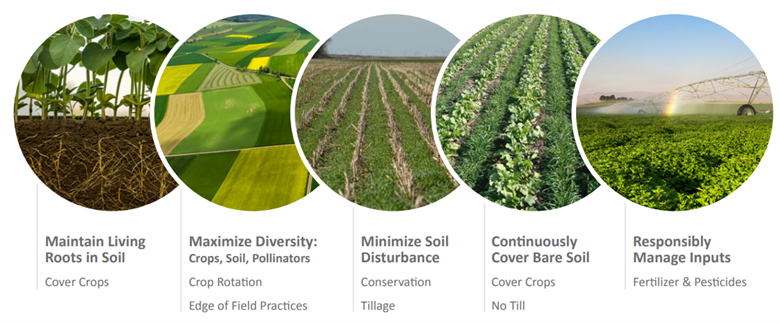
The five pillars form the backbone of ADM’s sustainability framework. But the company’s real strength, Combs emphasized, lies in its scale and farmer partnerships.
“ADM works globally with over 30,000 producers on eight different crops and on 5 million acres to support regenerative programs on farm,” she said. “We have great people partnering with our farmers globally.”
Building a regenerative value chain
ADM’s regenerative agriculture program is not a top-down corporate initiative, but a collaborative system that connects farmers to markets, data and incentives. This ensures on-farm changes are both environmentally meaningful and economically viable.
ADM builds its global framework on four core pillars:
- Education
- Partnership
- Economic incentives
- Technological innovation
“ADM approaches this as a value chain collaboration,” she said. “We’re in this together with our farmers all the way down to the end consumers, but we start with our farmers.”
The education component begins in the field. ADM organizes multiple field days throughout the year where regenerative growers can exchange ideas, see new technologies and learn about region-specific management strategies, from cover cropping to precision nutrient application.
“Farmers who are engaged in regen ag can come onto a farm, learn about new technology, learn about how to best implement regen ag practices, take that back to their farm and engage on their farm,” she said.
The partnership pillar centers on technical assistance and peer-to-peer learning. ADM connects producers to trusted regional experts who can advise on equipment adjustments, cover crop selection or the logistics of transitioning to no-till systems.
“As farmers are managing the transition, they can call technical partners like American Farmland Trust or Practical Farmers of Iowa (PFI) in the US who can answer questions and be on farm to help them. We want to make sure our farmers feel supported while they’re engaged in regen ag,” she said.
From an economic standpoint, ADM incentivizes specific practices in specific regions.
“There are different programs and practices available for our farmers, and ADM financially incentivizes those practices,” she said.
By linking rewards to measurable practices like cover cropping or reduced tillage, ADM gives producers a pathway to profitability during the learning phase of adoption. These incentives are complemented by technological innovation that ensures transparency and credibility.
ADM partners with Gradable, a joint venture platform that manages farmer enrollment, data collection and impact verification. Gradable aggregates information on crop management, soil health and emissions outcomes to quantify ecological benefits and support downstream sustainability claims.
“They work with our farmers, so at the end of the year, there is a data package that we can use to better understand the ecological benefits that are coming out of the farm,” she said.
This data-driven approach allows ADM to verify progress against measurable sustainability metrics.
Linking consumer demand to farm-level benefits
While regenerative agriculture begins at the soil surface, its success ultimately depends on the market’s willingness to reward sustainable practices.
“ADM keeps a really close pulse on what’s going on in consumer demand, so we can develop programs that make the most sense for farmers and consumers,” Combs said. “We know that consumers are rather familiar with regen ag, but they know less about what the real impacts are. We have some work to do to continue to educate consumers on what regen ag is and how it changes the products they’re buying.”
That said, consumer interest is clearly trending upward, and many are willing to pay more for products labeled as regenerative.
“We’re always looking for opportunities to connect regen ag value from the consumer back to our farmers,” Combs noted.
ADM’s position across the global food value chain of linking crops, feed and finished animal products puts it in a unique position to facilitate that connection.
Opportunities for dairy and livestock operations
Although much of ADM’s regenerative work focuses on crops like corn, soy and wheat, the company also sees major potential for livestock and dairy producers to participate.
“Dairy operations have some great opportunities,” she explained. “Right now, we are looking at what we can do to help improve the efficiency of silage crops and production which might include cover cropping or a change in tillage practices.”
Beyond crop management, nutrient recycling through manure application plays an essential role in regenerative systems. Properly managed, manure is a renewable source of fertility that reduces the need for synthetic fertilizers.
As consumer awareness grows and regenerative frameworks become more defined, ADM expects new technologies and market mechanisms to support livestock operations to bring a differentiated product to market and monetize their environmental performance.
Global effort rooted in local contexts
ADM’s regenerative agriculture program spans continents, from North and South America to Europe to Australia. But the company’s approach remains locally focused, adapting to each region’s agronomic conditions and cultural context.
“ADM sees each region as locally focused,” Combs said. “We have teams in various regions to help support both our farmers and the customers down the value chain.”
This global-local balance ensures that regenerative programs reflect local realities like soil types, rainfall, cropping systems and economic conditions, while contributing to global sustainability goals. It also reinforces ADM’s belief that regen ag must be economically sustainable to endure.
Combs said the company’s farmer-first approach is key to building trust and long-term resilience. By offering financial incentives, technical support and market access, ADM is helping producers navigate one of agriculture’s most transformative shifts in decades.
“We really approach it as a farmer-first program and look at it as a holistic way to help not just farmers but everybody across the ag value chain,” she said.
ADM’s work underscores a simple truth: regenerative agriculture is no longer a niche concept – it’s a blueprint for the future of global food production.
To learn more about ADM’s regen ag program, click here.

Sarah Mikesell
Sarah Mikesell grew up on a five-generation family farming operation in Ohio, USA, where her family still farms. She feels extraordinarily lucky to get to do what she loves - write about livestock and crop agriculture. You can find her on LinkedIn.